


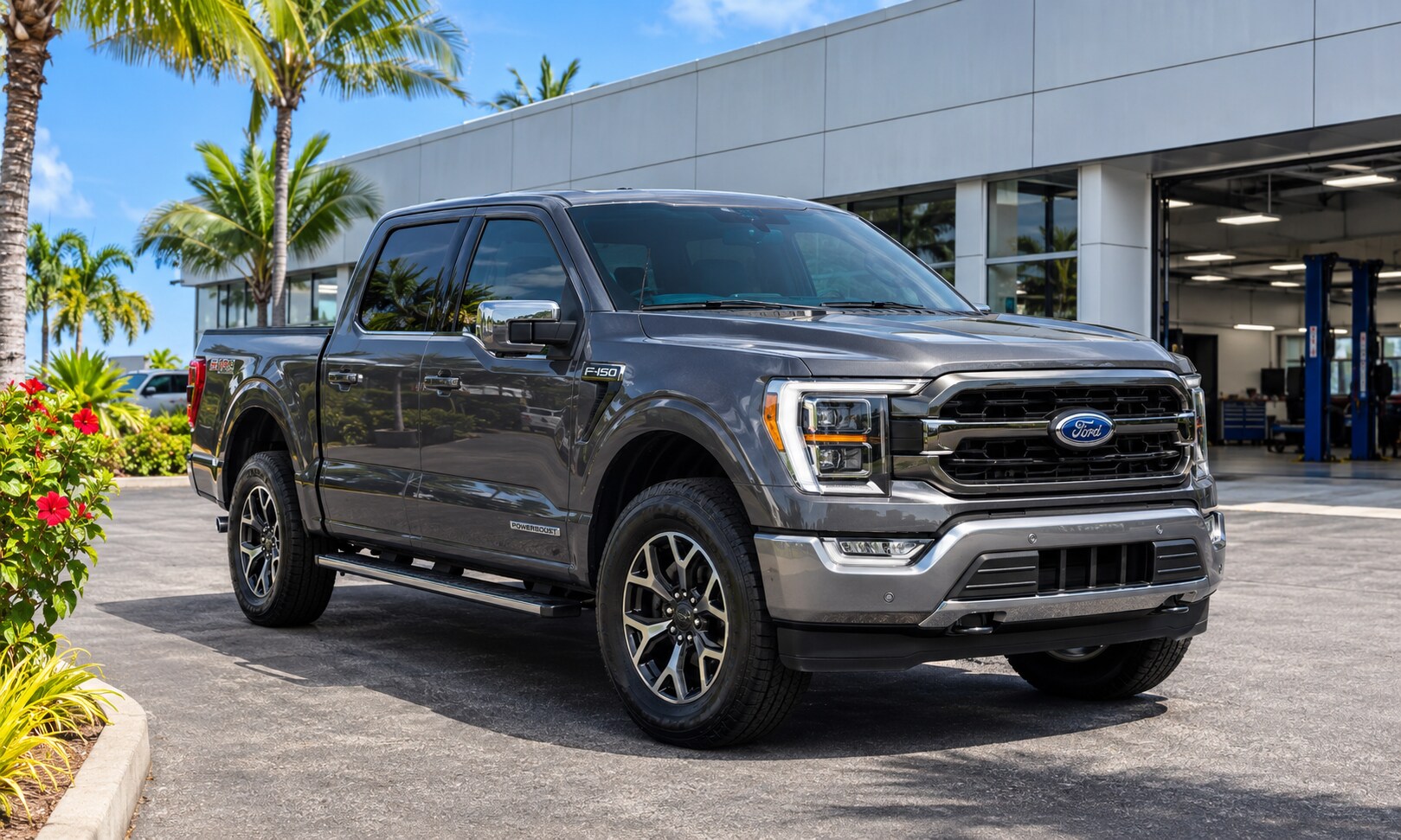
If you're considering a Ford F-150 PowerBoost Hybrid, you probably have questions about its battery. How long will it last? Will Oahu's warm weather affect it? And what happens if the hybrid system needs attention after several years of ownership?
These are reasonable questions, especially when you're buying a truck you plan to keep for a long time. The F-150 PowerBoost combines a gasoline engine with an electric motor and a high-voltage battery, adding technology that works differently from a traditional gas-only pickup.
At Cutter Ford in Aiea, we help Ford owners explore their maintenance and repair options. This guide explains how the PowerBoost battery works, what Ford's warranty covers, and what to watch for as your truck gets older.
How Does the Ford F-150 PowerBoost Hybrid Battery Work?
The Ford F-150 PowerBoost uses a full-hybrid powertrain that combines a 3.5-liter EcoBoost V6 gasoline engine with an electric motor and a high-voltage lithium-ion battery. The two power sources work together to help the truck accelerate, operate efficiently under suitable conditions, and provide the capability expected from an F-150.
Unlike a plug-in hybrid, the PowerBoost doesn't need to be connected to a charging station. Its battery receives energy through the vehicle's hybrid system, including regenerative braking. When you slow down, the electric motor can recover some of the energy that would otherwise be lost during braking and store it for later use.
This is one reason hybrid technology can be useful during Oahu's stop-and-go driving. Whether you're commuting through Honolulu or traveling between Aiea and Pearl City, the system automatically manages gasoline and electric power according to driving conditions.
Ford explains these functions in its official hybrid vehicle technology overview.
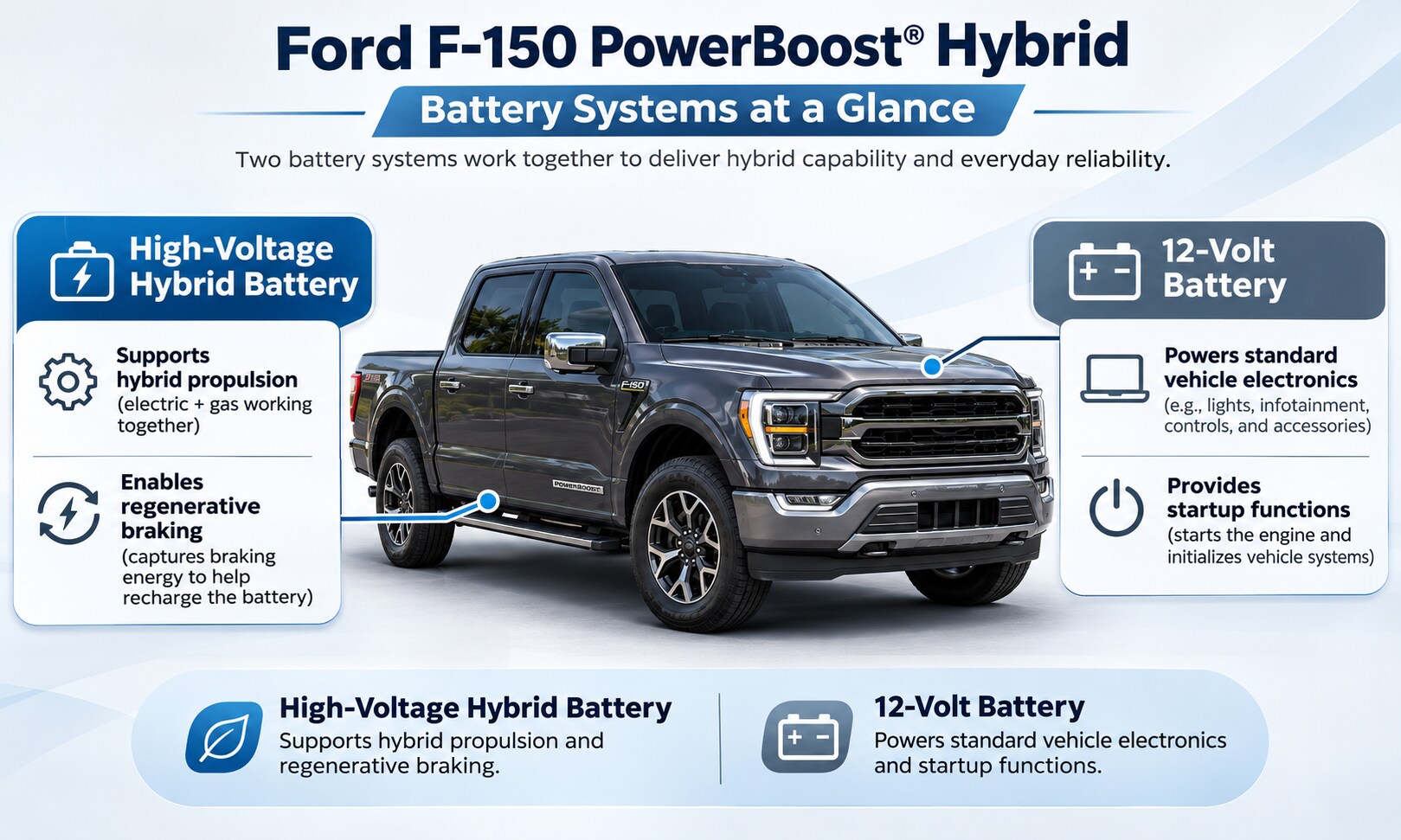
It's also important to know that your PowerBoost has more than one battery system. The high-voltage battery supports hybrid propulsion, while the low-voltage electrical system serves other vehicle functions. A problem with one shouldn't automatically be assumed to be a problem with the other.
How Long Does an F-150 Hybrid Battery Last?
There isn't a single mileage figure that tells you exactly when an F-150 PowerBoost battery will need replacement. Its useful life depends on several factors, including age, operating conditions, usage, and the health of the overall hybrid system.
Like other rechargeable batteries, a hybrid battery can gradually lose some capacity as it ages. That doesn't mean it will suddenly stop working after a particular number of years. Normal capacity loss and an actual component failure are different conditions, and they may require different responses.
Drivers should also distinguish battery lifespan from warranty duration. A warranty tells you how long certain qualifying problems may be covered; it doesn't predict when the battery will fail or guarantee its condition beyond that period.
For Oahu owners, the practical approach is to follow Ford's maintenance recommendations, pay attention to warning messages, and have unusual changes in vehicle performance evaluated rather than assuming the battery needs replacement.
Does Hawaii's Climate Affect Hybrid Battery Life?
Temperature can influence battery performance and long-term aging. High temperatures can increase stress on lithium-ion batteries, although the PowerBoost has systems designed to manage battery operating conditions.
Oahu's warm weather doesn't mean every PowerBoost battery will experience premature wear. Vehicle age, driving conditions, storage practices, and the condition of the vehicle's thermal-management system also matter.
Follow the storage and operating instructions in your specific owner's manual. If your truck will be parked for an extended period, check Ford's recommendations instead of assuming the same storage procedure applies to every model year.
For a truck used regularly around Honolulu, Kapolei, or the Windward side, keeping up with scheduled maintenance is a more useful habit than trying to predict battery life from Hawaii's weather alone.
What Does Ford's F-150 Hybrid Battery Warranty Cover?
Ford provides separate warranty coverage for certain hybrid and electric drivetrain components. For the 2026 model year, Ford's published Hybrid/Electric Vehicle Unique Component coverage lasts eight years or 100,000 miles, whichever comes first.
The high-voltage battery is among the components covered under the applicable warranty terms. Other covered components may include certain high-voltage connections and electronic control equipment, depending on the vehicle.
However, this doesn't mean every battery-related concern qualifies for a free replacement. Warranty coverage depends on the cause of the problem, the vehicle's age and mileage, its service history, and the applicable exclusions.
Ford also distinguishes a qualifying component failure from normal battery aging. Gradual loss of battery capacity due to ordinary use is not covered under the New Vehicle Limited Warranty.
| Warranty consideration | What owners should know |
|---|---|
| Hybrid component coverage | Eight years or 100,000 miles for applicable 2026 vehicles, whichever comes first |
| High-voltage battery | Included among applicable hybrid components |
| Normal capacity loss | Excluded when resulting from gradual aging and normal wear |
| Warranty repairs | Require evaluation under Ford's applicable terms |
| Used F-150 PowerBoost | Remaining coverage depends on the vehicle's original warranty timeline and mileage |
For the most accurate information, consult the official 2026 Ford Warranty Guide or the warranty documentation for your particular model year.
If you're purchasing a used PowerBoost, review its original in-service date and mileage before assuming any hybrid battery warranty coverage remains.
Signs Your F-150 Hybrid Battery May Need Attention
A hybrid battery problem doesn't always produce the same symptoms. Some issues trigger a dashboard warning, while others may become noticeable through changes in how the vehicle operates.
Ford identifies reduced fuel economy and certain charging-related problems as potential reasons for inspecting a hybrid battery system. However, symptoms alone cannot establish that the high-voltage battery is failing.
Pay attention to the following changes:
- Hybrid system warning messages: An unfamiliar warning or malfunction indicator deserves attention, especially if accompanied by other symptoms.
- Unexpected changes in fuel economy: A significant, unexplained drop may warrant inspection, although tire condition, driving habits, traffic, and mechanical issues can also affect mileage.
- Changes in vehicle performance: Unusual hesitation, limited power, or other abnormal behavior should be professionally evaluated.
- Persistent charging or electrical-system concerns: These may involve the battery, related electronics, or another part of the vehicle's electrical system.
If your truck displays a warning, note the exact message and when it appeared. Your model year, mileage, recent driving conditions, and any additional symptoms can help the service team understand the concern.
Don't assume every issue requires a new hybrid battery. Proper diagnosis helps identify whether the problem involves the high-voltage battery, another electrical component, or an unrelated vehicle system.
How to Maintain Your F-150 Hybrid Battery on Oahu
The F-150 PowerBoost hybrid battery isn't a component owners should open, disconnect, or attempt to repair themselves. Its high-voltage electrical system presents serious safety risks, even when the truck appears to be switched off.
For everyday ownership, the most useful maintenance approach is to follow Ford's instructions and keep the vehicle's supporting systems in good condition.
Follow the recommended maintenance schedule. Your owner's manual provides maintenance guidance for your model year and configuration. Routine inspections can also identify other problems that may affect how the truck operates.
Pay attention to cooling-system warnings. The hybrid system relies on appropriate temperature management. Avoid modifying or obstructing manufacturer-designed cooling components, and arrange professional evaluation if a relevant warning appears.
Use the correct storage procedures. Extended periods without driving can create additional battery-maintenance considerations. Review your owner's manual before storing the truck for a deployment, extended vacation, or other lengthy absence.
Don't attempt high-voltage repairs. Leave battery removal, high-voltage cable work, and internal battery inspection to personnel qualified and equipped for the particular procedure. Orange high-voltage cables and warning-labeled components should never be treated as ordinary wiring.
Keep an eye on normal vehicle performance. If you notice repeated warnings or substantial changes in how the truck drives, don't clear the messages and assume the issue has been resolved.
These habits won't guarantee a particular battery lifespan, but they support responsible ownership and help identify concerns that may need attention.
Ford F-150 Hybrid Service and Diagnostics at Cutter Ford
If you're concerned about your PowerBoost battery, the first step is to describe the symptoms and confirm the appropriate service options for your truck.
Our Ford Service Center in Aiea provides vehicle maintenance, diagnostics, battery services, and other mechanical repairs. For an issue involving the PowerBoost high-voltage system, contact us before booking so our team can confirm the available diagnostic or specialized service arrangements for your particular vehicle.
This is especially important because ordinary 12-volt battery testing and high-voltage hybrid battery diagnosis are not the same service.
You can begin through our online service appointment request. If you're unsure which service to select, call our department and explain the dashboard message or performance problem you're experiencing.
Cutter Ford Service Department
98-015 Kamehameha Hwy
Aiea, HI 96701
Phone: (808) 564-9216
If you're considering a new F-150 PowerBoost instead, you can explore our new Ford inventory. Availability and configurations change, so confirm the powertrain and equipment on the exact truck you're interested in.
Make Hybrid Battery Care Part of Your F-150 Ownership Plan
The F-150 PowerBoost battery is an important part of what makes the hybrid truck work, but it shouldn't be something you need to worry about every time you drive. Understanding the system, following Ford's maintenance guidance, and responding to unusual symptoms are sensible steps for long-term ownership.
Remember that battery lifespan and warranty coverage are two different things. Ford provides defined coverage for qualifying hybrid components, while normal battery aging is handled differently under the warranty terms.
If your PowerBoost is showing a warning or you're unsure what maintenance applies to your model year, we're here to help you explore the next step.
Request Ford Service Online or call (808) 564-9216 to discuss your F-150 hybrid concerns with our service team.