


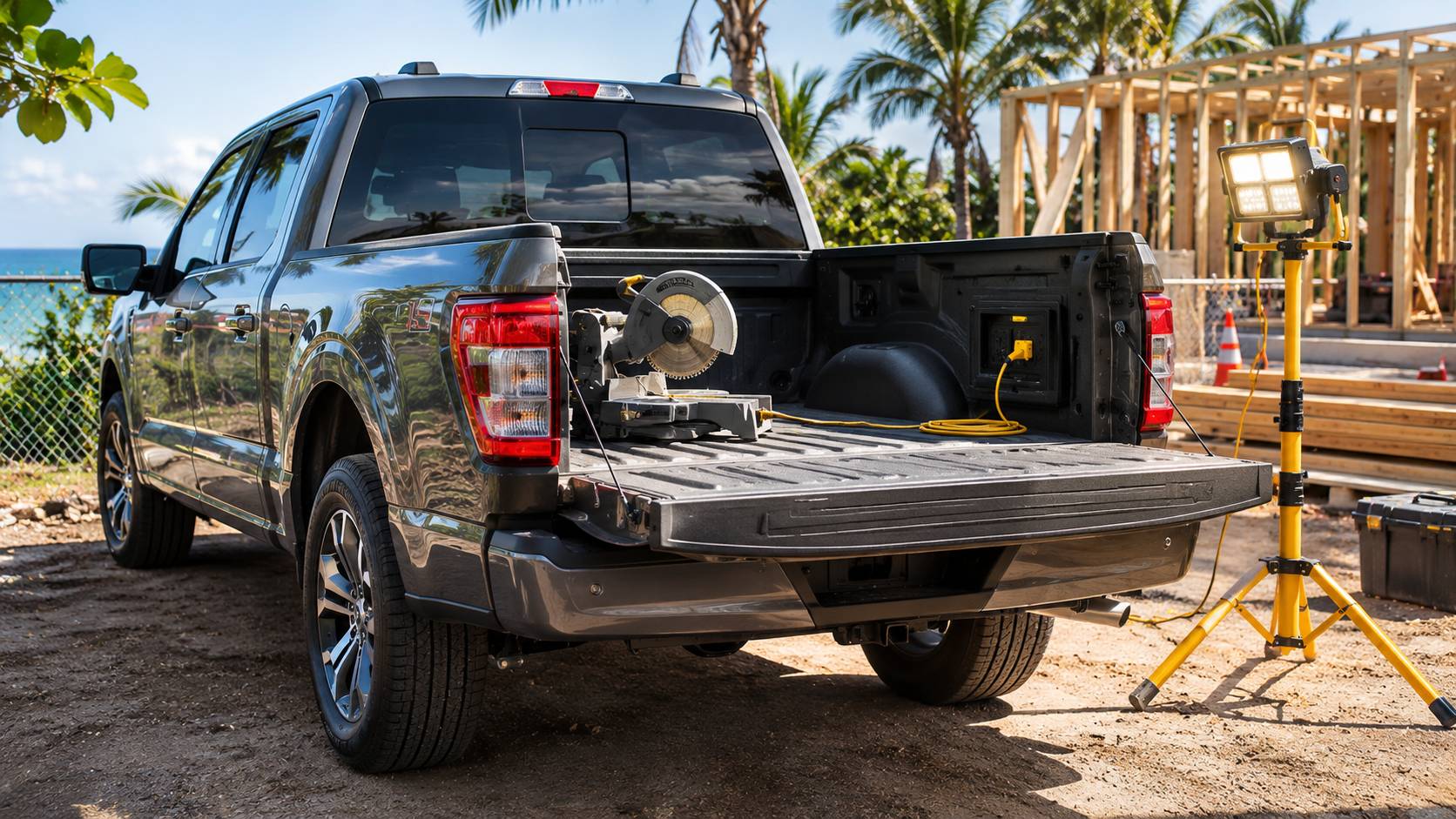
Imagine reaching a job site in Kapolei and needing electricity for your tools, only to find there isn't an outlet nearby. Or maybe you're planning a weekend outside with equipment that needs more power than a portable battery can provide. With the available Ford F-150 Pro Power Onboard system, your truck can serve as a convenient source of electricity in situations like these.
Pro Power Onboard provides electrical outlets powered by the truck, allowing drivers to operate compatible tools and devices when a conventional power source isn't available. Depending on the F-150's equipment, the system can support anything from smaller electronics to certain power tools and household essentials.
At Cutter Ford in Aiea, we help Oahu shoppers explore Ford trucks and compare available equipment. If Pro Power Onboard is on your wish list, here's what the system does, how its power ratings differ, and what you should know before choosing an F-150.
What Is Ford F-150 Pro Power Onboard?
Ford Pro Power Onboard is an integrated electrical power system available on certain F-150 configurations. Instead of carrying a separate portable generator for every job, owners can use the truck's built-in electrical outlets to power compatible equipment.
The system is designed to provide electricity while the vehicle is parked and operating according to Ford's instructions. It can be useful for outdoor projects, mobile workspaces, and situations where access to conventional electrical outlets is limited.
The amount of power available depends on the specific truck. A smaller Pro Power Onboard system may be suitable for charging devices or running modest electrical loads, while a higher-output configuration can support more demanding equipment.
For example, Ford offers an available 7.2 kW Pro Power Onboard system on appropriately equipped F-150 models with the 3.5L PowerBoost Full Hybrid V6 engine. Ford's F-150 specifications provide additional information about current equipment and available configurations.
It's important to remember that Pro Power Onboard is not standard at the same output level on every F-150. The truck's engine, equipment package, and installed outlets determine what it can support.
How Much Electricity Can the F-150 Provide?
The number that matters most when comparing Pro Power Onboard systems is their electrical output, measured in watts or kilowatts. One kilowatt equals 1,000 watts, but that doesn't mean every device drawing less than the system's total rating can automatically be connected to any outlet.
Individual outlets and circuits have their own limits. The system's combined capacity also matters when operating multiple devices simultaneously.
For the 2026 F-150, Ford identifies several available Pro Power Onboard configurations:
| System rating | General use |
|---|---|
| 400 W | Charging electronics and operating compatible small devices |
| 2.0 kW | Certain portable tools and moderate electrical loads |
| 2.4 kW | Compatible tools, electronics, and selected household equipment |
| 7.2 kW | Higher-demand equipment and multiple compatible devices, within outlet and circuit limits |
These descriptions illustrate potential applications rather than guaranteeing compatibility. Actual equipment requirements vary, and the specific F-150 must have the corresponding Pro Power Onboard system installed.
Ford's 2026 F-150 model information lists available outlet configurations and equipment options. When comparing trucks, pay attention to the exact power rating rather than assuming every vehicle with bed-mounted outlets has the same capability.
Understanding Running Watts and Startup Power
Some electrical devices require more power when starting than they use during normal operation. Equipment with electric motors, including certain saws and compressors, may draw a brief surge before settling into its regular operating load.
For example, a tool rated to operate at 1,200 watts may require additional power when its motor starts. Whether it can run safely depends on its actual specifications and the limits of the truck's electrical system.
Before connecting equipment, check the manufacturer's electrical rating and startup requirements. If you're planning to use several devices at once, add their expected loads and account for any overlapping startup demand.
Using Pro Power Onboard for Work on Oahu
For contractors and tradespeople working around Oahu, access to electricity can make a difference when planning a job. A truck with the appropriate Pro Power Onboard system may help operate compatible tools at locations without accessible outlets.
Consider a contractor working at an outdoor installation site. Instead of arranging a separate power source for every small task, the crew may be able to connect a suitable work light or power tool directly to the truck. Ford specifically identifies equipment such as miter saws and small air compressors as potential uses for higher-output systems, subject to their electrical requirements.
The system can also be useful for equipment charging. Portable electronics, compatible tool chargers, and other modest loads may be practical applications, depending on the truck's configuration.
However, Pro Power Onboard doesn't automatically replace every jobsite generator. Heavy equipment may exceed the available output or require connections the truck doesn't provide. Worksites should also follow applicable electrical safety requirements.
If you're considering an F-150 for business use, we recommend listing the tools you expect to operate and checking their power requirements before selecting a truck. Our team can help you review Ford's published equipment information and compare available F-150 configurations.
Can Pro Power Onboard Help During an Oahu Power Outage?
An F-150 equipped with the appropriate Pro Power Onboard system may provide temporary electricity for certain household essentials during an outage. Depending on the installed system and the equipment involved, that could include compatible lighting, a refrigerator, or communications equipment.
This can be useful when planning for unexpected interruptions, but it's important to understand the system's limitations. Not every F-150 can supply the same amount of electricity, and operating several appliances at once may exceed its available capacity.
There are also important safety considerations.
Never run a gasoline-powered F-150 or PowerBoost hybrid inside a garage, carport, or enclosed space to supply electricity. Vehicle exhaust contains carbon monoxide, an invisible and potentially deadly gas. The CDC's carbon monoxide safety guidance warns against operating motor vehicles in attached garages, even with the garage door open.
When using the system, follow Ford's operating instructions and position the vehicle outdoors so exhaust cannot enter the home or another occupied space. Use appropriately rated electrical equipment and keep connections protected from moisture.
You should also never connect a truck's power outlet directly to a household wall outlet. This unsafe practice, known as backfeeding, can create serious electrical hazards.
Powering a home's electrical panel requires compatible transfer equipment, professional installation, and approval where required by the local electric utility. Ford has published information about compatible home-power arrangements for certain vehicles, but compatibility and authorization must be confirmed before installation.
For most owners, the starting point is identifying which essential devices they want to operate and determining whether their vehicle can support those loads safely.
Which Ford F-150 Should You Choose?
If Pro Power Onboard is one of your main reasons for shopping for an F-150, begin with the electrical equipment you plan to use rather than choosing a trim based only on its appearance or other features.
Someone who primarily needs to charge electronics may not require the same system as a contractor planning to operate power tools. Drivers interested in temporary power for selected household appliances should also consider the type of outlets available and whether the truck's configuration supports their intended use.
The 3.5L PowerBoost Full Hybrid V6 is particularly relevant to buyers looking for the available 7.2 kW system. However, the presence of the hybrid engine alone does not establish that a specific truck has the highest-output configuration.
Before purchasing, check the following details:
- The exact Pro Power Onboard rating listed for the truck.
- Available outlet locations, voltage, and circuit limits.
- Whether your equipment's running and startup requirements are compatible.
- The truck's other equipment, including cab size, drivetrain, and payload capacity.
- The operating and safety instructions in the correct model-year owner's manual.
You can begin your research with Ford's F-150 model specifications and compare them with the vehicles currently listed in our new Ford inventory.
Because configurations and availability change, we recommend confirming Pro Power Onboard equipment on the exact vehicle before making a purchase decision.
Find an F-150 With Pro Power Onboard at Cutter Ford
Pro Power Onboard can make an F-150 more useful for certain work and everyday situations on Oahu. The key is choosing a system that matches what you actually need to power while understanding its operating limits.
At Cutter Ford, we can help you explore new Ford trucks and discuss available configurations. Whether you're comparing powertrain options or looking for a particular equipment package, our team can help you identify the information needed to make a more informed decision.
Visit us at 98-015 Kamehameha Hwy, Aiea, HI 96701, or start by browsing our new Ford inventory. If you're also considering financing, our Finance Center provides information about available purchase and lease options.
Call Cutter Ford Sales at (808) 564-9777 and ask about F-150 models equipped with Pro Power Onboard. Tell us what equipment you want to operate so we can help you review the appropriate specifications before your visit.